Security and GDPR for Your Business App: The SME Guide
How to secure your business app and comply with GDPR. 7 pillars, compliance checklist, and best practices for SMEs.
41% of cyberattacks target SMEs — and in 60% of cases, the company hadn't updated its software or implemented basic protections. Meanwhile, GDPR fines reached €2.1 billion in 2025 across Europe. For an SME running a business application containing client data, security and compliance are no longer optional — they're survival conditions.
This article gives you the practical keys to secure your business application and comply with GDPR without becoming a cybersecurity expert. Concrete, measurable actions you can take today.
Why Security Is a Leadership Issue
IT security isn't a technical topic reserved for the IT team. It's a business risk that leaders must manage alongside financial and legal risk.
3 Impacts of a Security Breach for an SME
- Financial impact — The average cost of a cyberattack for an SME is €25,000 to €50,000 (data loss, business downtime, remediation). In severe cases, this figure can exceed €200,000
- Reputational impact — 78% of clients say they lose trust in a company after a data breach. For an SME, trust is the primary commercial asset
- Legal impact — GDPR provides for fines of up to 4% of annual revenue for serious violations. Regulatory inspections are increasing, including for small businesses
A well-secured business application costs €2,000 to €5,000 more to develop. A security incident costs €25,000 on average. The maths speaks for itself.
Foreign SaaS vs Custom Tool: Where Is Your Data?
When you use an American SaaS tool (CRM, project management, file storage), your data is often hosted in the United States, subject to the Cloud Act and potentially accessible to American authorities — even if the provider has servers in Europe.
Since the invalidation of Privacy Shield (Schrems II ruling, 2020), transferring personal data to the United States is legally fragile. In practice, this means your GDPR compliance is compromised as soon as you store client data with a provider subject to US law.
Advantages of Custom Tools for Data Sovereignty
| Criteria | US-Based SaaS | Custom Tool (EU-Hosted) |
|---|---|---|
| Data location | USA (or Europe by configuration) | France / Europe (contractually guaranteed) |
| Third-party data access | Possible (Cloud Act) | Impossible (except European judicial authority) |
| GDPR compliance | Fragile (Schrems II) | Native (compliant by design) |
| Backup control | Limited (depends on provider) | Full (you choose frequency and location) |
| Data ownership | Check the terms of service | Total (contractually guaranteed) |
For a detailed understanding of why custom tools offer better control than generic SaaS, read our comparative analysis.
Sound familiar?
Estimate the cost of your custom tool
In 30 seconds, receive a personalized estimate based on your actual needs.
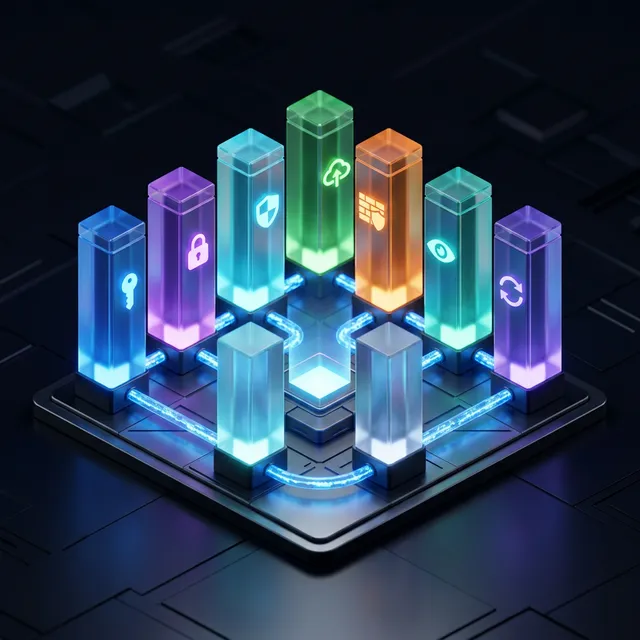
The 7 Pillars of Business Application Security
Business application security rests on 7 foundations that every serious development partner must integrate from the design phase — not after deployment.
1. Secure Authentication
Every user must be reliably identified before accessing the application:
- Strong passwords — Minimum 12 characters, with complexity requirements and encrypted storage (never in plain text)
- Two-factor authentication — A temporary code sent by email or generated by an app. Blocks 99% of fraudulent access
- Lockout after failed attempts — Access is blocked after 5 unsuccessful attempts
2. Access Rights Management
Each user should only see and modify what concerns them:
- Defined roles — Administrator, manager, operator, client. Each role has specific permissions
- Least privilege principle — A user should only have access to data strictly necessary for their work
- Audit logging — Every sensitive action (modification, deletion, export) is tracked and timestamped
3. Data Encryption
Data must be unreadable if intercepted:
- In transit — All communications between your browser and the server are encrypted (security certificate, secure protocol)
- At rest — Data stored in the database is encrypted. Even with physical server access, data is unusable
4. Automated Backups
Data loss is a permanent risk:
- Daily backups — Automatic, encrypted, stored at a geographically separate location
- Restoration testing — A backup that's never been tested is worthless. Restoration tests should be performed quarterly at minimum
- 30-day retention — Ability to revert to a previous state in case of data corruption
5. Protection Against Common Attacks
Web applications are exposed to well-known attacks:
- Code injection — Malicious data inserted via forms to access the database. Countered by systematic input validation
- Request forgery — Requests sent on behalf of a legitimate user. Countered by unique security tokens
- Denial of service — A massive flood of requests making the application unavailable. Countered by rate limiting and a web application firewall
6. Monitoring and Alerts
Early detection is the best defence:
- 24/7 surveillance — Response times, error rates, suspicious login attempts
- Automatic alerts — Immediate notification for anomalies (traffic spikes, server errors, unauthorised access attempts)
- Monthly reports — Summary of security status and interventions performed
7. Continuous Security Updates
Security isn't a state — it's an ongoing process:
- Monthly patches — Application of security updates to software components
- Annual audit — Complete review of security posture and configurations
- Active monitoring — Tracking new vulnerabilities affecting the technologies used
GDPR: What Your Application Must Comply With
The GDPR (General Data Protection Regulation) applies to any application that processes personal data of European residents — whether clients, employees, or prospects.
The 6 Key Obligations
| Obligation | In Practice | Impact on Your Application |
|---|---|---|
| Consent | Users must explicitly agree to their data being processed | Forms with opt-in checkboxes, no pre-ticked boxes |
| Purpose limitation | Data is only collected for a specific, documented reason | No "just in case" fields — every data point has a justification |
| Data minimisation | Only collect data that's strictly necessary | Fewer fields = fewer risks = lower costs |
| Storage duration | Data isn't kept indefinitely | Automatic deletion after the legal retention period (24 months by default) |
| Right of access and deletion | Users can request their data or its deletion | Export and deletion functionality built in |
| Breach notification | In case of a leak, the authority must be notified within 72h | Documented and tested procedure |
GDPR "by Design" vs GDPR Added After the Fact
The difference is fundamental:
- By design — Compliance is built into the architecture from day one. Technical choices (encryption, retention periods, access rights) are made during design. Additional cost: €2,000 to €5,000 in development
- Added after the fact — The application exists, and you need to make it compliant retroactively. Changes are heavier, riskier, and more expensive. Typical cost: €5,000 to €15,000, with no guarantee of complete coverage
At Iselia Projects, GDPR is integrated from the design phase. Our ongoing support plans include compliance as standard, not as an option.
Ready to take the next step?
Let's talk about your project
Free analysis of your needs, no commitment. We respond within 24 hours.
What to Verify with Your Development Partner
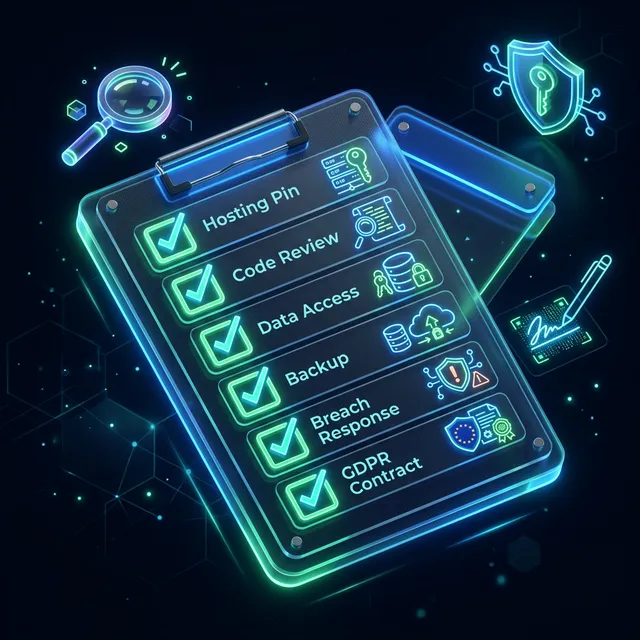
When entrusting your business app development to a partner, here are the security and compliance questions to ask before signing:
- Where will my data be hosted? — The answer must be specific: country, hosting provider, deployment region
- Is the code regularly audited? — A serious partner performs security reviews and applies patches monthly
- Who has access to my production data? — Only strictly necessary personnel should have access, with traceability
- How are backups managed? — Frequency, encryption, storage location, tested restoration procedure
- What happens in case of a security breach? — Response time, notification procedure, remediation plan
- Does the contract include a GDPR clause? — A data processing agreement (Article 28) must be signed
To learn how to evaluate a partner beyond security, check out our upcoming article on choosing a development partner. To estimate the security budget for your app, our development cost guide details the line items.
Frequently Asked Questions
How much does it cost to secure a business application?
Security integrated from the design phase adds €2,000 to €5,000 to the development budget. This covers secure authentication, encryption, access management, protection against common attacks, and native GDPR compliance. It's a negligible investment compared to the cost of a security incident (€25,000 on average).
Does my application need to be GDPR-compliant even if it's internal?
Yes. As soon as your application processes personal data of employees (names, emails, phone numbers), it's subject to GDPR. The obligations are identical whether it's client data or internal data. Regulators make no distinction.
Do I have to host data in my country?
No. GDPR requires that data be hosted within the European Economic Area (EEA) or in a country offering an adequate level of protection. Hosting in your specific country isn't mandatory but is recommended for sensitive data. At Iselia Projects, we systematically deploy to the Paris region to guarantee proximity and sovereignty.
What is "security by design"?
Security "by design" means that protection measures are integrated into the application's architecture from its initial design, rather than added afterwards. This includes encryption, authentication, access management, and GDPR compliance. It's more effective, cheaper long-term, and compliant with Article 25 of the GDPR.
Is my development partner responsible in case of a data breach?
Partially. GDPR distinguishes between the "data controller" (you, the company) and the "data processor" (the partner). Both share responsibility. A data processing agreement (Article 28) must be signed to define each party's obligations. Without this contract, you bear full responsibility.
How can I verify that my application is secure?
A security audit can be performed at any time. It checks server configurations, application protections, password management, encryption, and backup procedures. Typical cost: €1,500 to €3,000 for a standard business application. We recommend an annual audit at minimum.
Conclusion: Security Is an Investment — Not a Luxury
Securing a business application and ensuring GDPR compliance means protecting your company, your clients, and your reputation. For €2,000 to €5,000 integrated from development, you avoid incidents that cost 5 to 10 times more.
GDPR compliance isn't a bureaucratic obstacle — it's a competitive advantage. SMEs that can demonstrate compliance win the trust of increasingly demanding clients when it comes to data protection.
Is your current application secure and compliant? At Iselia Projects, the security audit of your existing tool is free and with no obligation. In 30 minutes, we identify potential vulnerabilities and propose a concrete action plan. Request your free audit →
Ready to go custom?
Need a custom business tool?
Let's discuss your project. Free analysis, no commitment.