How to Choose the Right Custom App Development Partner
8 criteria, 5 red flags, and a selection framework for choosing the right custom development partner for your SME.

52% of software development projects fail or exceed their budget — and in the majority of cases, the problem isn't technical. It's a problem of choosing the wrong partner. A brilliant developer who vanishes after delivery. An agency that promises everything and delivers half. A consultancy that bills for two management layers while one person codes.
Choosing the right partner for your custom business application is the decision that determines everything else: the budget, the timeline, the quality, and above all, the longevity of your tool. This guide gives you an actionable selection framework, the red flags to watch for, and the right questions to ask.
The 3 Partner Profiles
Before choosing, you need to understand the options. The custom development market divides into 3 categories, each with its strengths and limitations.
The Freelancer
Profile: independent developer, usually specialised in 1–2 technologies. Works alone or in an informal network.
Strengths: lower daily rate (€350–€600), direct communication, flexibility.
Limitations: uncertain availability (one project at a time? or several in parallel?), no continuity guarantee in case of illness or business closure, post-delivery maintenance rarely structured.
Ideal for: simple, short-duration projects (corporate website, quick prototype, add-on module).
The Specialised Agency
Profile: 2 to 15-person structure, specialised in a type of project or technology. Strong client proximity.
Strengths: focused expertise, single point of contact, contractual commitment on deliverables, structured maintenance, service continuity.
Limitations: limited capacity (2–5 projects in parallel), intermediate pricing (€600–€900/day).
Ideal for: strategic business applications for SMEs and mid-market, projects requiring long-term commitment.
The IT Consultancy
Profile: large structure (50–10,000+ employees), broad offering covering multiple technologies and sectors.
Strengths: significant capacity, enterprise references, certified compliance.
Limitations: high daily rate (€700–€1,200), team turnover, management layers that don't write code, heavy processes, often impersonal client relationships.
Ideal for: complex projects requiring a 5+ person team, strictly regulated environments.
| Criteria | Freelancer | Specialised Agency | IT Consultancy |
|---|---|---|---|
| Daily rate | €350 – €600 | €600 – €900 | €700 – €1,200 |
| Typical project budget | €10,000 – €25,000 | €15,000 – €50,000 | €40,000 – €150,000 |
| Delivery timeline | Variable | 4 – 12 weeks | 3 – 9 months |
| Single point of contact | ✅ | ✅ | ❌ (turnover) |
| Structured maintenance | Rare | ✅ | ✅ (expensive) |
| Code ownership | ✅ | ✅ | Check carefully |
For a detailed budget comparison by partner profile, check our complete guide to custom development costs.
The 8 Criteria for Choosing the Right Partner
Beyond price, here are the 8 criteria that separate a successful project from one that goes off the rails.
1. Source Code Ownership
The rule: the code must belong to you 100% from delivery. Source code, technical documentation, server access — everything must be in your hands. If the partner refuses or ties ownership to a maintenance contract, that's a major red flag.
2. Quote Transparency
A good quote details every line item: design, development per module, integrations, testing, deployment, training. If the quote fits on one page with a lump sum and no breakdown, you can't compare or challenge.
3. Contractual Scope Commitment
Budget and functional scope must be locked by contract before development begins. If the scope changes mid-project, the partner must tell you before — never after, never on the final invoice.
4. Verifiable References
Ask for 3 similar projects with contacts you can call. Not logos on a website — real people who've worked with this partner and can speak about their experience.
5. Working Methodology
How does the partner organise the project? Regular access to a test version? Weekly progress calls? Step-by-step validation? The methodology should be clear and documented before the project starts.
6. Post-Delivery Maintenance and Support
What happens after delivery? Does the partner offer a structured maintenance plan? What's the response time for a critical bug? Maintenance is what determines the lifespan of your tool. For more on this topic, see our practical maintenance guide.
7. Technical Quality
Ask for a code sample or access to a demo project. Clean, documented, tested code is the sign of a partner who builds to last — not to deliver and disappear.
8. Cultural Fit
You'll work with this partner for weeks, perhaps months. Communication must be fluid, vocabulary understandable (no unexplained technical jargon), and values aligned. If the first call goes badly, the project won't go better.
Sound familiar?
Estimate the cost of your custom tool
In 30 seconds, receive a personalized estimate based on your actual needs.
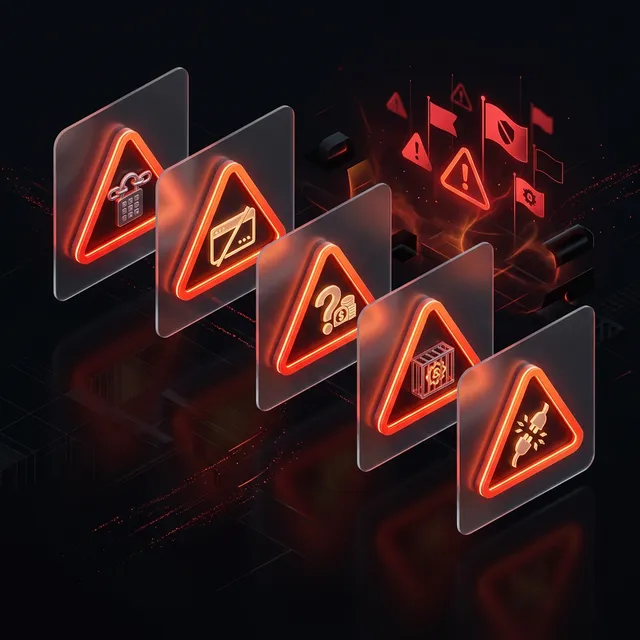
The 5 Red Flags to Watch For
These signals should alert you during selection. A single one justifies looking elsewhere:
- "The code belongs to us, you receive a usage licence" — Walk away. You must own the code, not rent it. This is non-negotiable
- "We can't provide references" — A partner without verifiable references is either too new or in conflict with former clients. Either way, the risk is too high
- "The final budget will be known at project end" — Without commitment on scope and budget, you're signing a blank cheque. Every project must have a detailed quote and contractual commitment
- "We use a proprietary framework" — A tool built with proprietary technology makes you dependent on that partner. Widely adopted, standardised technologies guarantee your freedom
- "Maintenance isn't necessary" — Every serious partner knows maintenance is essential. Claiming otherwise is selling fiction
The Right Questions to Ask in a Discovery Call
During your first exchange with a potential partner, ask these 10 questions. The answers will tell you everything:
- How many similar projects have you completed? — Look for industry experience, not just technical
- Who will be my day-to-day contact? — You should speak to the person who designs and develops, not a salesperson
- How do you handle scope changes mid-project? — The answer reveals the partner's maturity
- What's your response time for a critical bug? — Under 4 hours on business days is a good standard
- Can you show me code you've produced? — Code quality is a direct indicator of professionalism
- How is your quote structured? — Line by line, with payment milestones tied to deliverables
- Will I own the code 100%? — The only acceptable answer is "yes, unconditionally"
- What happens if you're no longer available? — A serious partner has a continuity plan (documentation, knowledge transfer)
- How do you ensure my application's security? — Read our security and GDPR guide to evaluate the answer
- Can you put me in touch with a former client? — This is the ultimate test. A "no" is a red flag
Ready to take the next step?
Let's talk about your project
Free analysis of your needs, no commitment. We respond within 24 hours.
Real-World Case Study: The SME That Changed Partners Twice
The Initial Situation
Company: 35-person industrial SME specialising in mechanical subcontracting. Need for a production tracking tool.
Partner 1: The "Cheap" Freelancer
- Quote: €12,000 — the lowest of 3 proposals received
- Delivery: 6 weeks late, missing features
- Post-delivery: the freelancer stopped responding after 3 months. No documentation
- Result: €12,000 lost + an unusable tool
Partner 2: The "Reassuring" Consultancy
- Quote: €45,000 — "in line with market standards"
- Reality: 3 different contacts in 4 months (turnover). The project manager didn't understand production processes
- Delivery: 8 weeks late, final budget: €62,000 (+38%)
- Post-delivery: maintenance at €1,200/month, with 5 business-day response times
- Result: a delivered but inadequate tool, blown budget
Partner 3: The Specialised Agency
- Quote: €28,000 — detailed line by line, locked by contract
- Delivery: in 7 weeks, on scope. Single contact from start to finish
- Post-delivery: maintenance at €400/month, 2-hour response time
- Result: working tool, adopted by teams, ROI achieved in 8 months
Total cost of the initial wrong choice: €12,000 + €62,000 = €74,000 wasted before finding the right partner.
The lesson: the cheapest partner is almost never the least expensive. And the biggest isn't necessarily the most effective.
Our Position at Iselia Projects
At Iselia Projects, we're an agency specialised in custom business application development for SMEs. Here's what we guarantee:
- ✅ 100% code ownership — Code, documentation, and access belong to you from delivery
- ✅ Locked budget — Scope, budget, and timelines fixed by contract before we start
- ✅ Single point of contact — You speak to the person who designs and develops your tool
- ✅ Structured maintenance — Plans starting at €300/month, guaranteed responsiveness
- ✅ Verifiable references — Contact our clients, ask your questions
Discover our full support offering →
To structure your requirements before contacting a partner, check our requirements document guide.
Frequently Asked Questions
Should I always choose the cheapest quote?
No. The cheapest partner is rarely the least expensive in the end. A low quote may hide undelivered features, poor-quality code, or no maintenance. Compare quotes for the same scope, and evaluate quality, references, and contractual commitment.
How many quotes should I request?
3 quotes is the right standard. Fewer than 3, you lack comparison. More than 5, you waste time and dilute your attention. Send a structured requirements document to each partner for comparable quotes.
How do I verify a partner's references?
Ask for 3 contacts from previous clients and call them. Ask: was the project delivered on time? Was the budget respected? How is maintenance? Would you recommend this partner? A partner who refuses to provide contacts is a warning sign.
Can I change partners mid-project?
Yes, if you own the code. This is precisely why code ownership is criterion number 1. A serious partner documents their work and facilitates transfer if needed. Transition cost is typically €3,000 to €8,000 for onboarding.
Do I need a signed contract?
Absolutely. A contract must cover: functional scope, budget, timelines, payment milestones, code ownership, maintenance terms, and termination conditions. Without a contract, you have no protection in case of dispute.
Local agency or offshore partner?
A local partner (in your country or the EU) costs more per hour but offers decisive advantages: proximity, communication ease, legal compliance, and legal recourse. Offshore development may seem economical but generates hidden costs (communication, time zones, variable quality) that often cancel out the initial savings.
Conclusion: The Right Partner Is Your Best Investment
Choosing the right custom development partner means investing in a trust relationship that determines your project's success. Price, code ownership, transparency, references, maintenance — every criterion matters.
Take time to compare, ask the right questions, and verify the answers. A wrong choice costs 2 to 3 times more than getting it right the first time.
Ready to evaluate your project with a transparent partner? At Iselia Projects, the needs analysis and quote are free and without obligation. In 30 minutes, you'll walk away with a detailed estimate and clear answers to all your questions. Request your free quote →
Ready to go custom?
Need a custom business tool?
Let's discuss your project. Free analysis, no commitment.